
Industrial Training Company in Patna
6 Months Industrial Training for B.Tech / MCA Students
Nexozia Technologies, a prominent IT company in Patna, Bihar, offers a comprehensive six-month industrial training program designed specifically for B.Tech and MCA students as part of their academic requirements from accredited universities or institutes. Many students miss out on crucial hands-on experience by choosing training centers or non-software development companies. To make the most of your industrial training, it's important to consider the following points before enrolling with any organization:
- Is the company a registered software development firm? If not, you could waste six months and regret your decision later.
- Does the organization offer training on live projects or dummy projects? Be cautious, as some companies may promise live project training without being engaged in active software development.
- Are live projects hosted online? If your project is live, ensure it’s hosted online so you can present it to potential employers when job hunting.
- Will you be placed in the Software Development department? Some students join large companies only to end up in customer support, technical support, marketing, or data collection roles instead of software development.
- What types of projects will you work on? Verify that the projects offered will allow you to learn and apply the latest technologies effectively.
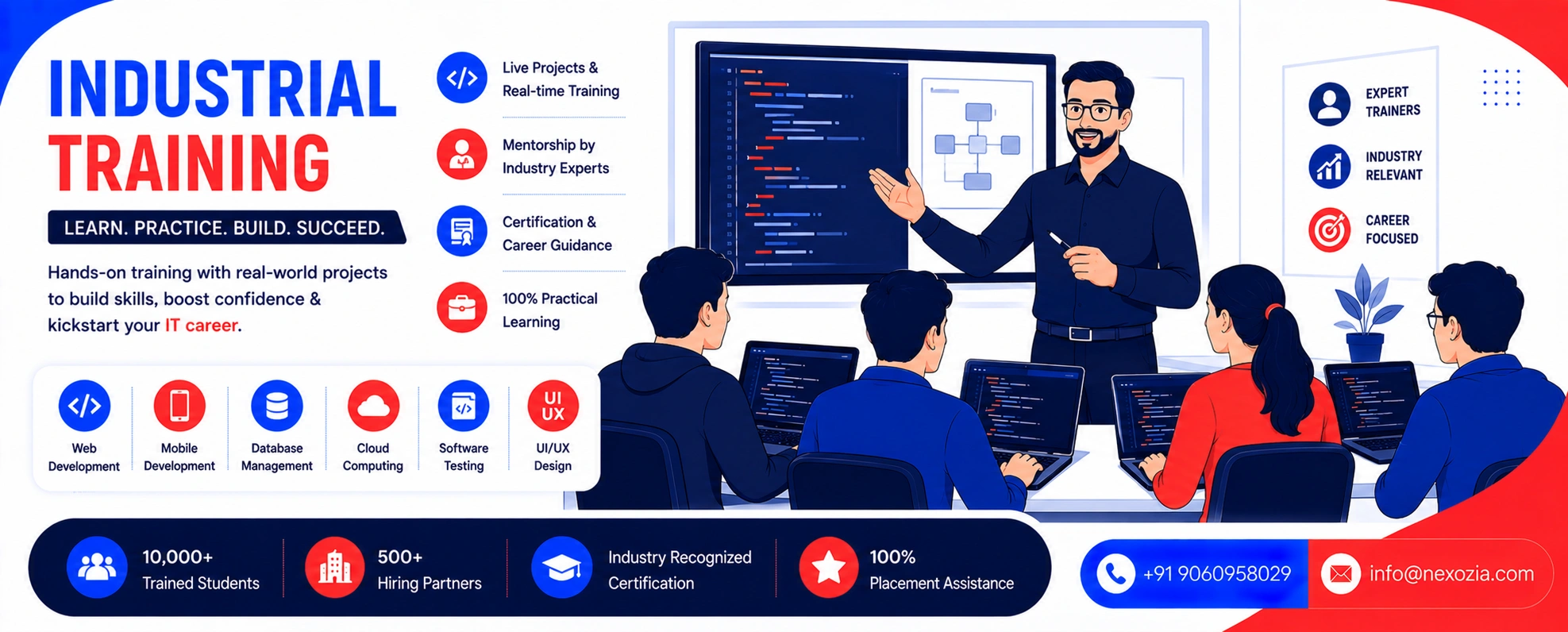
At Nexozia, we have a team of highly skilled PHP specialists who help students master the latest PHP technologies, including PHP 5. Our team works on real-world projects, guiding students through scripting for corporate functions and boosting their confidence in web development. The training is project-based, and students receive a certification upon successful completion of both the training and project execution.
PHP remains one of the most widely used open-source, server-side scripting languages, particularly for web development. It powers numerous websites and blogs, and can easily be integrated into HTML.
At Nexozia Technologies, students work alongside experienced software developers under the supervision of seasoned project managers. Our training program includes both theoretical and practical components, allowing students to gain in-depth knowledge of the software development lifecycle while working on live projects.
Our six-month industrial training program is paid, and we offer only 10 seats. Interested candidates must visit our office with a recent resume, a training letter from their institute, identity proof, and two passport-sized photographs. Please note that the training fee is non-refundable, and no stipend is provided during the training. Selection is based on an interview process. Office hours for visits are from 10:00 AM to 6:00 PM.
Kickstart your career with Nexozia Technologies. by joining our hands-on internship program designed for passionate learners. At Nexozia, interns work on real client projects, gain practical industry experience, and learn directly from experienced professionals. This internship is ideal for students and freshers who want to build strong technical skills and a professional portfolio. If you are eager to learn, innovate, and grow in the IT industry, we would love to hear from you. Apply now by sending your resume to career@nexozia.com or connect with us on WhatsApp: +91 9060958029.




Industrial Training FAQs
Find answers to common questions about our Industrial Training FAQs, including features, benefits, pricing, and support. Explore the frequently asked questions below to learn more.
Industrial Training is a service or solution designed around the specific requirements of its target users. The project scope may include planning, design, development, content or data setup, testing, deployment, and future improvements. The final features depend on the business goals, audience, workflows, and technical requirements discussed during consultation.
A properly planned industrial training solution can improve online visibility, simplify operations, support customer or user engagement, and reduce manual work where applicable. The exact benefits depend on the project type, target audience, internal processes, and required integrations. A requirement-based approach helps prioritize the features that are most useful for your organization.
Yes, the scope can be customized according to your branding, workflows, users, content, features, and future plans. Customization may include page layouts, dashboards, forms, user roles, notifications, reports, integrations, and administration tools. Before development, the requirements should be documented so that deliverables, priorities, and technical limitations are clearly understood.
Features depend on the service and the users who will operate the solution. Possible components may include responsive interfaces, admin management, search and filtering, enquiry forms, reports, notifications, user accounts, content management, payment options, or third-party integrations. A detailed feature list should be finalized after reviewing your specific business requirements.
Mobile-friendly implementation can be included for websites, portals, dashboards, and user interfaces where responsive access is required. Layouts can be planned for desktop, tablet, and mobile screens. For mobile applications, the supported platforms and device requirements should be finalized separately so the development approach matches the intended users and functionality.
Integration may be possible when the existing system provides suitable APIs, documentation, authentication methods, and access permissions. Depending on the project, integrations may involve payment gateways, communication tools, CRM or ERP systems, analytics, maps, databases, or external platforms. Technical feasibility, data security, and maintenance requirements should be reviewed before implementation.
The cost depends on the project scope, number of pages or modules, design complexity, customization, integrations, user roles, testing, hosting, and support requirements. A fixed amount should not be assumed without reviewing the requirements. A project-specific quotation can be prepared after the expected features, technology, deliverables, and priorities are discussed.
The timeline depends on the complexity of the project, content or data readiness, design approvals, integrations, revisions, testing, and deployment. A smaller project may require less time than a platform with multiple workflows, dashboards, or user roles. A practical schedule can be discussed after the scope and milestones have been finalized.
Existing websites, applications, or software can be reviewed for redesign, feature improvements, performance updates, migration, security work, or maintenance. The recommended approach depends on the current codebase, hosting environment, database, documentation, and technical condition. An initial assessment helps determine which parts can be retained and which require modification or redevelopment.
You can contact Nexozia Technologies with your requirements, reference examples, preferred features, budget range, and expected timeline. The team can review the information, clarify the project scope, and discuss suitable next steps. For enquiries in Patna, location-specific coordination can also be discussed during consultation.